Ummmmm…………LUNCH IS LOOKING AT ME

Colombia.

Home of even more great roads.

The Colombian road builders have a great sense of adventure. I can picture the discussion, “Don’t build the road through the valley, let’s see if we can actually make it follow the ridgeline all the way. Twenty pesos says you can’t”.

I’m glad someone took the bet.

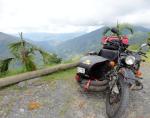
The roads are spectacular:  1000 foot drops on each side of the road, pavement twisting along the ridges, fog sweeping up the hillsides increasing the drama of the region. We follow a local semi-truck.  He is pulling a full-size trailer. The road is two lanes with no shoulder. After an hour of trying, we can’t pass him. It isn’t that he is blocking the road.  We can’t pass him because he is flying!

I try my best to keep up by sticking close and following his passes. “If he is going it must be safe, right?” It’s a good thing that the game only lasts an hour.

The tires are squealing,

the brakes are squealing,

the wife is squealing. 

Then we reach the valley floor. A quick fuel fill up and we’re off to repeat this game several times over the course of the day. Any of the passes would see me arrested in our home country but here in Colombia it is how you get it done.

It’s another national holiday. 

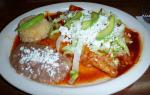
Sancocho, one of Colombia’s favourite dishes is on the menu for the special occasion.  So we gotta try it. But what is it? Pollo. Chicken – sounds good. Order up three.

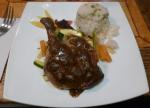
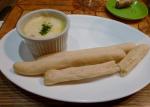
Course one arrives – chicken soup. Looks good. Tastes great. What’s next?  Sausage – sort of.  The next course arrives. Ummmm. Why is my lunch looking at me? It is about 6 inches high, a chicken neck with the head still attached, all the inside removed except the eyes and it is stuffed and standing up on the plate, staring me down.

It is tasty, but I have to eat all three.

Stefan and Tracey decide that it is not for them.

We stop in a village just south of Popayan to find accommodation.  A kind gentleman on a motorbike offers to assist and leads us to a place south of town where we are greeted by a friendly family who shows Tracey a room that is available for the night.  As she checks out the room, she can’t help noticing that it is clearly being occupied.  There are personal items everywhere in the room.  As she looks around, members of the family are hustling around clearing up all evidence of inhabitation.  We accept the accommodation and within minutes the room is readied with fresh bedding and towels.  Shortly afterward, the family piles into two taxis and are gone. 

We never see them again.  Thankfully there is a caretaker on site who locks up for the night and makes a lovely breakfast the next morning, but I can’t help feeling as if our arrival has left the family without a place to stay themselves and picture them bunking with unsuspecting friends in order to make room for us.  Based on the hospitality we have seen so far in Colombia, this wouldn’t surprise me. 

The next day we have a surprise – the best burger I have ever had. We arrive in town in the dark, in the rain, in the cold.

Our hotel room is so small the door catches on the bed. No danger of falling out of bed – there’s not enough room! We are hungry. The restaurant is closed. The desk clerk hands us a take out menu from a local restaurant. Wow, some great local dishes on the menu.

But when we order we hear

“Nope, out of that.

Nope out of that too.

Nope. Nope.” 

We finally get down to “What do you have?”

“Hamburgers” is the reply. Well, I guess we will have burgers. The burgers arrive. They are unbelievable. Fresh chopped beef, a great bun, a slice of ham, cheese, fried onion, avocado, and tomato topped with a mysterious crunchy shred of something. In case that was not enough they put on a chicken breast too.

Chicken is like salt down here, it comes on everything. The burger is amazing, a complex collection of great flavours. I just about stay another day, just to have another one.

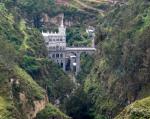
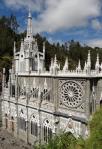
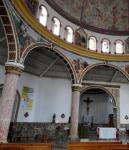
Our last stop in Colombia is at Santuario de Las Lajas, a strange but spectacular sight.  The neo-Gothic Santuario is built on a stone bridge spanning a deep gorge.  It’s also a hugely popular destination for pilgrims in need of a miracle.  Pilgrims’ plaques of thanksgiving line the walls of the canyon. They have placed their faith in the Virgin Mary, whose image is believed to have emerged from an enormous vertical rock 45m above the river sometime in the mid-18th century.  The church is directly against the rocky wall of the gorge where the image appeared. The church is a spectacular sight. 

Ecuador beckons – here we come.

Miles
This slideshow requires JavaScript.

AHH, THE SMELL OF COFFEE

Eventually, we make it to Medellin, a city that no traveler would have considered passing through fifteen years ago. The city was once known as the murder and violence capital of the world. Thanks to a massive effort by the government and a tremendous amount of local pride, Medellin is now considered a safe city and a great place to visit. The streets are clean and lined with scupltures and local artwork.

Later in the day we head into El Eje Cafetero (the coffee region), home of Colombia’s number-one drink and its biggest (legal) export.  The area is blessed with magnificent mountain scenery and coffee plants covering nearly every slope. In a country where we have seen many spectacular landscapes, this region provides the most beautiful mountain scenery yet. To add to the pleasure, the smell of coffee is strong in the air. I may not be a coffee fan, but there is no denying that the smell is fabulous.  

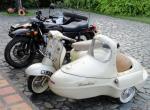
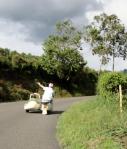
Our destination for the day is Pereira, the coffee region’s largest city. A chance encounter on our second day in the city leads us to the perfect home-away-from-home. As I stand on the side of the road fielding endless questions from the locals, a beautiful pale yellow Lambretta motor scooter pulls up behind the Ural, and off hops its driver sporting a helmet emblazoned with the Union Jack. I immediately recognize that this is not a typical Colombian. I am about to meet one of the most enthusiastic two and three-wheel motoring enthusiasts we have ever encountered, British expat Alan Gardiner. Our meeting was meant to be.  We learn that Alan has a farm near Pereira which commonly serves as a hostel for motorbikers passing through the area. We take Alan up on his offer of accommodation at Villa Toscana. Alan’s home, with its lovely garden and pool, proves to be the perfect place to take a few days’ break from riding. We also thoroughly enjoy Alan’s company as we share passions for music and motoring. Alan is undoubtedly a wealth of knowledge when it comes to British Northern Soul music and Lambretta scooters. He has several Lambrettas in his collection, including one to which he has added a sidecar.

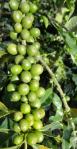
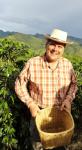
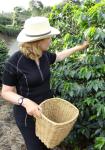
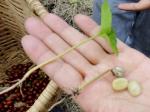
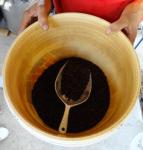
On one of our afternoons, Alan and his friend Luz organize us a visit to Villa Martha, an active coffee finca (farm). As we are in the midst of the main harvest time, we have an opportunity to go into the rows of small evergreen coffee bushes, seeing the coffee berries in various stages of ripeness. Berries are traditionally selectively picked by hand and we learn how to select berries at their peak of ripeness.  We pick several berries, peel them open to extract the seeds (commonly known as coffee beans) and then follow the beans through the stages of processing. First, the slimy layer of mucilage is removed from the bean, then it is washed to remove any residue. We watch some previously-picked beans finishing the roasting process and being ground and packaged. When we are offered a cup of sweet coffee at the end of our tour, I can’t refuse. Having just been involved in the entire process, I have to sample the final product. 

Tracey

This slideshow requires JavaScript.

RIDING WITH JUAN VALDEZ

So here we are in Colombia, once considered the most dangerous country in the world.  Although the country has implemented security improvements that are allowing it to slowly emerge from the extreme violence of past decades, my guard is up.  Although conditions have improved dramatically, Colombia can still be an unpredictable place, with flare-ups between guerilla and paramilitary factions.  But the locals certainly don’t appear to be living in a state of fear.  Most of the population has never before experienced such an era of peace.  Homicide rates in many Colombian cities where they were once among the highest in the world are now similar to some U.S. cities. 

I’ve been reading that the poorest Colombians can barely afford the necessities of life, but here in Cartagena, we are seeing a contradiction to this.  Though I suspect that this is the case in some of the country’s smaller pueblos where there is a lack of jobs, in the area of Cartagena where we are staying, citizens seem to be enjoying a life style of modern amenities, luxury homes, shiny cars, and posh restaurants.

Cartagena is said to have the most impressive old town in the Western Hemisphere so we spend the better part of a day walking through this area, surrounded by 13km of impressive centuries-old colonial stone walls built to protect the city against enemies.  I feel like we are stepping back in time as we are surrounded by colonial-era mansions and churches that are almost perfectly preserved.  Under our feet are streets of cobblestones and above us are tile roofs and rows of ornate balconies dripping with flowers. 

One morning, in search of a road map of the country (something that we had been lacking thus far on our trip), we head off with fellow motorbike travelers, Sarah and Malcolm from Australia, for a walk to the shopping mall.  Along the way, we see Convento de la Popa, sitting on Cartegena’s highest point and we also pass Castillo de San Felipe de Barajas, the castle built by the Spanish during the colonial era which once dominated approaches to the city by both land and sea.  We are pleased that we had some decent sightseeing on our walk because our search for a roadmap has proven fruitless.  Once again, we will be exploring with no map.

On our last evening in the city, our guest house is visited non-stop, both by Halloween trick-or-treaters and by many of our companions from the Stahlratte stopping by to wish us a continuing safe journey.  It was tough to say goodbye to everyone, not knowing if our paths would cross again.  Fortunately, we didn’t need to bid farewell to Stefan from Germany who will be riding with us for the next leg of our journey. 

Stefan, Miles and I head off from Cartagena, but not without some challenges.  It is All Saints’ Day, and the streets are lined with children and ladies singing, making music with pots and pans, and collecting food for the traditional feast.  Driving through the outer town, we see a very different city from what we had experienced in the historic district.   We were suddenly thrown into heavy traffic and chaos.    

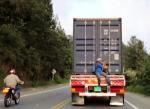
As we head south out of the city, it becomes even more obvious why traffic accidents are so common in Colombia.  Drivers are both aggressive and careless behind the wheel.  They aren’t following street signs or road markings, are passing each other left and right (literally), are towing cyclists who cling to their back bumpers, and are providing rides to pedestrians who jump onto their back bumpers and then hold on for their lives.  On the winding rural roads and high mountain passes, we witness many near-accidents and it feels like my heart is stopping with each one.

Near the end of our first day of driving we see heavy black smoke rising from the road ahead.  I imagine that my fears of a horrific motor accident have become reality.  As we get closer, we see close to a thousand protestors who have built a blockade across the road and set it on fire.  Although we never do understand what they were protesting, they certainly aren’t messing around.  In the end, it proves to be a positive experience as it forces us to do some off-road driving and takes us to a fabulous little village where the locals jump to their feet and cheer on our daring efforts to get around the blockade. 

On the sides of the road, we begin to see men who remind me of Juan Valdez.  I now feel that I have finally arrived in Colombia.  Admittedly, I am a victim of marketing when it comes to Juan.  He’s merely a fictional character used in advertisements to represent the Colombian coffee farmer, but he’s been in the media since before I was born and in my mind he is an icon of Colombia.  I couldn’t help thinking of Juan each time I spotted a farmer meandering down the road on his mule laden with heavy burlap sacks.

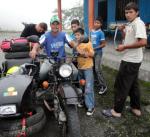
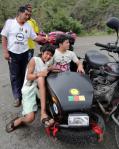
The next morning finds us once again driving into the clouds with lovely views of the valleys through filtered sunshine.  Unfortunately we are also facing a flat tire at the highest, coldest part of the road.  We pull off the road next to a house where a young boy is sitting on the veranda.  He quietly watches our entire tire-change process without uttering a word.  As we pack up and prepare to leave, he is joined by some friends and now suddenly has the bravery to come and speak to us and take some photos.  We are so glad that he did. 

Tracey

This slideshow requires JavaScript.

IT’S ALL ABOUT THE FOOD – PART ONE (well maybe part 125 by now)

Tracey says “you always say you travel for the food, but you haven’t really written about it.”

Well, here it goes.

As a chef, I learned that Mexico has one of the five ‘master’ cuisines, along with India, China, France, and the fifth one which I cannot remember (too many Pisco Sours I guess).  Mexico did not disappoint – Standouts included:

  • Menudo:  a tripe soup with fresh oregano, onions and lime in a thin broth with hominy. One of my all-time favourites.
  • Limonata:  a wonderful fresh lime juice with a touch of sugar and sparkling water.  This was made outstandingly by the bartender on the Mazatlan ferry.
  • Horchata:  a rice-based drink with vanilla and cinnamon.  Wow!  Made in a small village near Mezcal.
  • Hot Chocolate:  made fresh for Tracey.  The chocolate was ground in a mortar and pestle, added to rich milk, and cooked on a tin sheet – over a cactus wood fire no less.

I don’t think we had a bad meal in Mexico. We searched out roadside stands and only ate inside once!  The people are eager to add complex spices to the meals and the freshness was outstanding.

I have to mention the Chorizo.  Being a sausage freak, I was happy to try out every variation of sausage to be found. Where was the best? Easy answer! We stopped at a roadside stand in Guatemala, where a man with a mop was brushing his grill with water to create steam for the cooking sausages. They were amazing! Just the right amount of smoke and stuffed with a very herbal mixture. I could have stayed at this roadside stand for a week.

Antigua,Guatemala surprised me. Confit? That’s what the menu says. Do they actually cook them in the melted goose fat?  I must order it to find out.  It’s just OK – not completely traditional, but the ambience and the 35 year old rum contributed to a great night out. The Sangria was pretty good too and Tracey said the bread pudding was her favourite.  This same night we had an aperitif of hibiscus flowers and aguardiente (fire water) a great blend, not too toxic and very unique!

Nicaragua. In Leon we went to a traditional restaurant and I had the local specialty ‘Chanco con Yucca’ otherwise known as Sauerbraten. It was a fermented/pickled pork roast with a southern twist!

Gallo Pinto – rice and beans – all the time, everywhere – you can’t escape them.  The same with Pollo Asado – roast chicken. In Mexico I kept screaming ‘pollo asado’ every time we passed a sign advertising roast chicken, harping on about getting some. Never had any the entire time we were in Mexico. Good thing, Seven countries later and it is the only thing on every menu and most times the only thing on the menu. I’m ready for something different. Oh, the Gallo Pinto was best in El Salvador.

Motoring down the highway in Costa Rica, we spot a couple of semi trucks out in front of a restaurant and a couple of  local workers seem to be enjoying their meal inside. The decision is made, we pull in.  Uh Oh, it is a Chinese restaurant.  Well let’s try it anyway. One of the best chow meins we have ever had!

Panama forgot how to cook.  No salt, no spices, no flavour?  We ended up cooking our own food here, not for lack of trying the local fare. We went down to the ‘row’ where all the best restaurants were and……. Still the same result. Pack your own lunch here.

From Panama we hopped onboard the Stahlratte.  One night we set up a grill on the beach and made skewers of some local fish. I did not see the fish but it’s meat was the toughest I have ever seen! I could not cut it with a knife let alone chew through it. Pass the salad.  Otherwise the food on the boat was quite enjoyable.  I volunteered to do the cooking for our merry band of 25 travellers for a couple of days and had fun rifling through the galley and trying to build a meal. Thanks Ludwig for letting me play.

Colombia beckons. Stayed tuned it starts to get funky now.

 Cheers

Miles

This slideshow requires JavaScript.


THE END OF THE ROAD

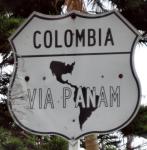
Eventually we head off again, toward the end of the road.  The Pan-American Highway does not go all the way through Panama but terminates in the middle of the jungle in the vast wilderness region of the Darien Province, before starting again 150km further on in Colombia.  This is the famous “missing link” of the Pan-American Highway that runs from Alaska To Puerto Montt,Chile – the break known as the Darien Gap.  It’s literally the end of the road.  Although a few intrepid travelers have crossed the gap, the area can typically be reached only by foot, boat, or small plane and any of these options are not terribly safe. 

Regardless of the lack of road, we are headed that way.  Our ride this morning takes us over seemingly endless steep hills and tight curves, largely on gravel roads.  It takes us into Panama’s wildest region, the most difficult to reach, and the reason that we were about to surrender our three wheels in exchange for a sailboat. 

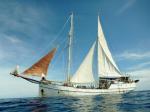
We have booked passage on the SV “Stahlratte”, not a commercial sailing vessel, but a boat owned by a non-profit foundation for the purpose of providing a traveling platform for group life experience.  The boat’s crew is composed of a captain and volunteers who work in a rotation system for three to six months without being paid.  The income generated by carrying passengers pays for the expenses of the crew and maintenance of this historic ship.

Stahlratte, a 40m long, 235 ton traditional sailing ship built in 1903 in Holland is very well maintained and equipped for worldwide high sea sailing.  It will make a spacious and comfortable home for the next four nights.

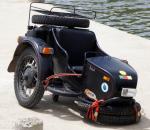
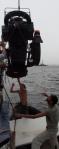
When we arrive at the dock, Miles quickly gets to the task of removing the sidecar from our Ural before both parts are lifted onto the Stahlratte directly from the dock by ropes and pulleys.  It is strange to have our three wheels separated for the first time in their life and even more strange to see our Ural dangling from ropes over the ocean.

On this journey, the Stahlratte will be carrying 15 bikes and their riders along with six other travelers.  There are several familiar faces as 13 of the other passengers had been staying with us at Panama Passage.  Captain Ludwig and his crew, Floyd and Nichole, are doing a fabulous job of making all of us feel at home onboard. 

Our route on the Stahlratte will take us along the Comarca de Kuna Yalais, a narrow, 226km long strip on the Caribbean coast that includes the Archipelago de San Blas, which stretches from the Golf de San Blás in Panama to the Colombian border.  The islands are home to the Kuna, who run San Blas as an autonomous region with minimal interference from the national government.  They have their own system of governance, language, customs and culture.

Most Kuna women continue to dress as their ancestors did.  Their faces are adorned with a black line painted from the forehead to the tip of the nose, with a gold ring worn through the septum.  Colourful fabric is wrapped around their waists as a skirt, topped by a short-sleeved blouse covered in brilliantly coloured molas (reverse appliqués).  The women wrap their legs from ankle to knee in long strands of tiny beads, forming colourful geometric patterns.  A printed headscarf and many necklaces, rings, and bracelets complete the wardrobe.  They are a beautiful sight.

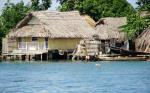
Forty of the San Blas islands are inhabited acre-sized cays packed with so many bamboo-sided, thatched-roof huts, people, and dogs that there is barely enough room to maneuver between them.  On our first day on the Stahlratte, the boat is anchored near a few of the inhabited islands and we have an opportunity to visit two of the them, wandering through the villages and enjoying a barbecue dinner and a presentation of traditional dance by a dozen of the islands’ younger inhabitants.

As tempting as the waters appeared on this hot afternoon, there was no swimming today.  A look at the number of outhouses perched over the ocean, was enough the change the mind of anyone tempted to dive in.

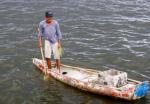
The next morning we awake to the view of dolphins swimming around the boat and islanders in their long carved canoes carrying passengers and goods between the islands.

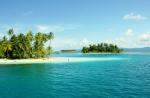
Today we head out on about a two-hour sail, heading toward what many would consider paradise-on-earth, Cayos Coco Bandero, a group of six uninhabited islands where we will remain anchored for two nights.  Most of the nearly 400 islands of San Blas look as if they are part of the set of Fantasy Island:  uninhabited islands covered by coconut trees and ringed by white-sand beaches with the turquoise Caribbean lapping at their shores.  It feels like heaven-on-earth to be able to jump off the side of the boat and swim to a nearby uninhabited island through warm clear waters and arrive on picture-perfect beach covered in 12 inch starfish.  A Kuna boat returns us to the island later in the day for dinner and a huge bonfire. Later in the evening, we watch sea turtles and rays swimming past the ship.  Even better, we are here for a second day, allowing us to repeat the experience all over again.  What more can I say.  Everything about our surroundings makes it feel as if we are living in a dream.

In a protectionist move to preserve local culture, the Kuna Congress passed a law several years ago that prohibits outsiders from owning property in the Comarca.  The law has kept foreign investment out of the region.  Knowing how protective the Kuna are of their environment it was difficult not to think about the impact that our visit was having on this community.  The revenue from our time on the islands, the transportation that we hire to get us from land to the boat, our dinner on the inhabited island, and the few coconuts that we purchase could play a role in the development of the region.  But we remain aware of not doing damage to the nature on the islands and of being sensitive to the plight of the Kuna.  We are conscious of being respectful of their culture, keeping covered up in the same way that they do.  Knowing that tourism is developing rapidly in the region, the invasion of foreigners poses a major threat to the preservation of Kuna culture.  The Kuna Congress has now started to debate the extent to which foreigners should be granted access to their Comarca.  In the years that follow, it is likely that the Kuna Congress will ban photography in certain areas while prohibiting tourist traffic in others.  We feel privileged to have had the opportunity to experience this culture while it is still possible to do so.

On our fourth morning on the boat, we awake to find that the ship has now set sail to Cartagena, Colombia, a trip that will take over 24 hours.  During the course of the day, the boat is passed over twice by a U.S. KC-135 military plane and also passes a submarine.  Knowing the volume of drug trafficking that takes place in these waters, all of this action makes me feel like we are somehow in the centre of an international drug ring.  Perhaps we are.

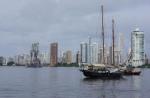
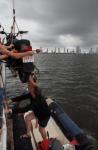
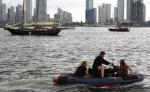
Heading up to the deck the following morning, we are already heading into the bay at Cartagena.  After several hours enjoying the views in the bay and waiting for our turn at customs, the time comes to unload the bikes.  Miles supervises the Ural being lowered onto a dinghy and then gingerly sits on top of two of our three wheels as they are transferred to solid ground.  Once the side car arrives on the next dinghy, he is back at work re-joining our three wheels and getting us back on the road, now on an entirely new continent.
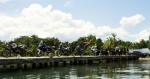
Thank you to Sandra, Jordan, Mirjam and Daan for the great photos of unloading our Ural in Cartegena.

Tracey

This slideshow requires JavaScript.