The sun is barely up as our train departs Ollantaytambo for Aquas Calientes at the base of Machu Picchu. To a never-ending soundtrack of pan flute music, the train zigzags through lush valleys hugging the Rio Urubamba. Entertainment is also provided by the other 50 tourists in the train car diving from side to side while snapping tremendous numbers of photos with their mobile phones. We are feeling very spoiled to have been immersed in spectacular scenery for months. I must admit that the view from the train seems quite pale by comparison.
After transferring from the train to a bus for a final steep climb, we arrive at Machu Picchu and the exploration begins. The site more than lives up to its reputation as one of the most spectacular archeological discoveries on earth. The ruins of the legendary “lost city of the Incas” sits majestically amid the highland jungle surrounded by the massive Andes.
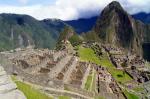
We head straight up the hill to a spot above the ruins that affords us the classic postcard view of the site. We are overlooking rows and rows of steep agricultural terraces being visited by a few grazing llamas. In the opposite direction, we look down on the Inca Bridge, built of stacked stones and overlooking a sheer drop of nearly 2000 feet.
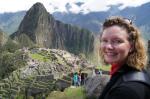
As we sit admiring the view, a thoughtful man named Tim approaches and asks if we would like him to take a photo of the two us with this spectacular backdrop. After some discussion, we discover that Tim and his wife, Sandy, are fellow Calgarians and are also friends with our traveling compatriots, Janet and Tom (www.adventurouspirits.com). All of us have been trying to plan our travels to meet up with Janet and Tom in Chile. Sandy also comes over to speak with us and we enjoy the opportunity to chat and put together the pieces that reveal that we have actually met before. We would certainly never have expected our second meeting to be thousands of miles from home at the top of Machu Picchu. Yet again we are amazed by the realization of how small our world is. We eventually accept that we need to get moving if we are going to see all of Machu Picchu today, so we part company and Miles and I trek down into the main section of the ruins, hiking and exploring for several more hours.
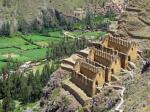
The next day, Stefan takes us to do some further exploring of the ruins he has discovered – right across the street from our hotel. We pass through an unassuming doorway and climb to the ruins of Pikuylluna. The climb is very steep but provides spectacular views of Ollantaytambo, the ruins across the gorge, and much of the valley. We take a different route down, ending up at a set of stairs that lead us back to Ollayntaytambo’s old town. I’m still amazed at the wonders of archaeology that lie around every corner in this fascinating country.
Tracey
This slideshow requires JavaScript.
The postcard view of Machu Picchu.
We made it!
Just can’t get enough of this view.
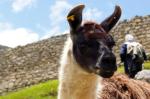
Llama enjoying the views at Machu Picchu.
Machu Picchu.
Hand-cut stonework at Machu Picchu.
Clay bricks drying along the path leading to Pikuylluna.
A view of Pikuylluna.
Overlooking Ollantaytambo.
Ollantaytambo’s old town.
After much discipline in keeping my many adorable dog photos out of the blog I had to slip in at least one.
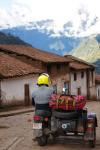
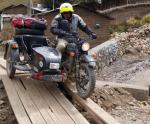
We are once again on steep dirt roads – steep dirt roads for as far as we can see. When we stop for a snack, the locals seem to think that we are more than a bit crazy to be continuing. They seem to be debating whether or not to turn back themselves. We continue, undaunted, dodging rocks and slimy puddles for hours. At one point we come across a muddy crossing that can’t be dodged. Recognizing that we are likely to be stuck without a lot of power to get us through, Miles opens up the throttle and we power into the water with an enormous splash. We come out the other side covered in red mud from head to toe but grinning from ear to ear. “That was a blast! Can we do it again?” We are truly a sight to be seen. As we make our way through a construction zone, all of the road workers can’t help stopping at the sight of us. One worker sees us coming from a distance, lifts his arms in the air as if he is about to cheer us on, but when we get close enough that he can see the state of us, his arms go down for the biggest knee-slapping laugh I have ever seen. We are definitely providing the entertainment for the afternoon.
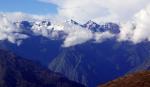
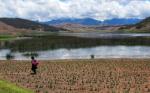
The next afternoon, Miles spots an interesting looking road that takes off from the side of the highway. On our map, it looks like it may be part of the fabled back-route to Machu Picchu. In an effort to avoid the busy tourist route that lies ahead of us, we give it a try. It provides some spectacular drives through remote farming villages where ladies young and old are herding their cows, sheep and pigs up and down the roads. I can quickly see why this wasn’t the recommended route. We are constantly dodging livestock and at one point are chased down the road by a lady with a big stick, apparently trying to herd us along with her animals. “Yikes. Is it time to turn back yet?” We continue and reach some spectacular views of the high Andes. It is amazing to look up at these mountains and know that the mysterious and beautiful Machu Picchu lays just on the other side. Unfortunately, though, the road ends at a glacier-filled rock wall and we have no option but to turn around and return the same way that we came, our destination so close and yet still very far away.
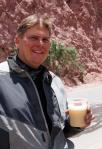
The next day, as we are approaching Urubamba, we see a tiny shack with a red flag, the local way of advertising that there’s home-brewed chicha available inside. We stop to try our first taste of this ancient Andean tradition we have heard much about, a beer made from fermented maize. It is served warm, in a well-used monstrous glass for just a few pennies. One glass is more than enough for all three of us, in fact one tiny glass of this fizzy, mouldy corn would have been more than enough for all three of us. We made it through but won’t be going out of our way to search for a waving red flag again.
We are now heading into the Sacred Valley of the Incas. The empire built several of their greatest temples, estates, and royal palaces nestled among these rugged mountains between Cusco and Machu Picchu. It is now a beautiful stretch of small villages and ancient ruins.
The villages of this valley remain starkly traditional. Quechua-speaking residents work the fields with primitive tools and harvest salt with methods unchanged since the days of the Incas. We first pass through the village of Urubamba before stopping in Ollantaytambo, a tongue twister of a town that has clearly received a lot of space in the Lonely Planet travel guide. After weeks of being off the beaten path, we suddenly find ourselves deep in the land of tourists.
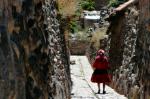
It is easy to see why so many are attracted to visiting here. The surrounding scenery is stunning: the snowcapped mountains that embrace the town frame a narrow valley where both sides lined are lined with Inca stone agricultural terraces. Searching for a hotel, Stefan and I wander through Ollantaytambo’s old town, a perfect grid of streets dating to Inca times. The streets are lined with stone walls, bougainvillea, and tiny canals carrying rushing water down from the mountains.
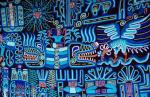
After checking into a hotel, we take a walk through the main plaza and across the Rio Patancha. Munching on a skewer of alpaca meat while wondering through the market stalls I can’t help stopping to admire some tapestries, hand-woven in brilliant colour. The ancient drop spindle, a stick and spinning wooden wheel used for weaving, is still used and for the past week we have seen women in colourful native dress pacing up and down roads absent-mindedly spinning the ancient spools or sitting chatting with friends with baskets of colourful wool at their feet. It’s great to now see some of their end-products.
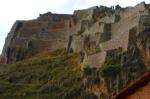
Further along the road we look up to see the ruins of a fortress built into the hillside. The ruins represent one of the Inca Empire’s most amazing feats of architecture, each stone perfectly fit. We thought we were just stopping on our way to Machu Picchu and now here we are standing in another unexpected archaeological wonder.
On our way back through the plaza, we join with the locals in the centuries-old tradition of chewing coca leaves to ease the effects of altitude. They taste… well… green. And they make my mouth kind of numb. Other than that, I don’t seem to notice any impact. Miles is liking them. Still, I won’t be adding coca chewing to my daily Andean routine.
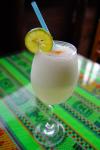
We stop for a late lunch and a long-awaited opportunity to try Peru’s national drink – the pisco sour. This is a delicious concoction from the white-grape brandy called pisco made frothy when mixed with egg whites, lemon juice and sugar. Miles had raved about this drink after an earlier trip to South America but wasn’t quite able to replicate it at home. It’s cold and complex – the closest thing to a Peruvian margarita. I think I will add this to my daily Andean routine, until I realize that after one pisco sour I’m having a hard time navigating my way down the street. I now understand the need for bordering the roads with high rock walls – they keep me from going too far astray.
Tracey
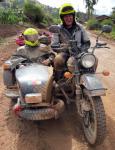
After Note: A huge thank you to Stefan Gardt for the tremendous photo of Smiles and Miles covered in Peruvian mud. This photo has now been used by Schuberth Helmets and featured in the December 2013 issue of Motorcycle Mojo magazine.
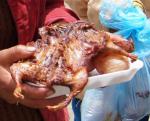
Getting out of Lima proves to be no easier than getting in. We spend two hours on the city’s freeways trying to find our way. After passing the highway exit a couple of times, we finally spot the tiny road sign that we have been searching for and are once again on our way into the Andes. We are headed for Ticlio Pass and Morococha, the highest passenger train station in the world at 4758m. At the top of the pass, we stop for lunch and Miles finally gets his chance to try cuy (guinea pig). Given that this is considered a delicacy throughout the Andes, he isn’t that impressed – lots of bones and not much meat to fill a hungry belly.
As we gain altitude, the scenery in the mountains is quite stark. We are often in deep canyons with rock on both sides and lots of tunnels. Our intended destination for the day is La Oroya, a bleak, cold mining town. It would not be worthy of a stop but for its ideal location at the end of our day’s travel and the fact that its streets are lined with hotels to house the mine workers. As we get closer to the town, we are constantly climbing in altitude. The higher we get, the colder we get and just minutes before we reach the town the skies open and we are soaked, making sure that if we aren’t already feeling well chilled, we are now. Stefan and I begin the task of finding a hotel, splitting up and then re-connecting to compare our findings. I am soaking wet, bulked up with six layers of clothing, and feeling very short of breath and a bit dizzy after an increase in altitude from sea level to over 4800m in under six hours. To make it more challenging, the reception for every hotel is on the second floor at the top of a steep flight of stairs. I climb a dozen of these staircases only to find that all of the hotels I check are either full or have no parking. Stefan’s luck isn’t any better and we are beginning to think that we’ll be continuing our chilly drive to the next town. Fortunately, there is one hotel left and it has a room for three and secure parking. The room is not great, but it is amazing what becomes acceptable accommodation when you are frozen, exhausted, light-headed and now starving.
The next day is sunny and much warmer. Following an early afternoon fuel stop in Huancayo, we travel a beautiful route that ascends on mountain contours then loops down to a narrow river valley and Izcuchaca before opening out again into lush alpine meadowland with artfully painted thatched-roof homes and wandering herds of llamas. It then spirals down into the valley and Huancavelica, our home for the night.
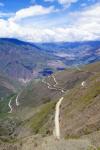
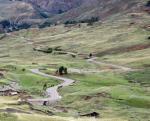
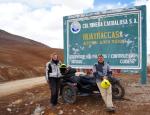
From here we head onto dirt roads. This is our opportunity for some real back-country adventure. We are headed to what is marked on our 30-year-old mining map as the highest road in the world at 5059m. It looks like the road never goes below 4700m for almost 200km. After many skinny twists and turns, we arrive at the pass and pose for the requisite photos. We have some sense of accomplishment, having potentially taken our Ural to the highest altitude that one of these Russian beasts has ever reached.
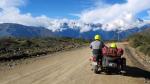
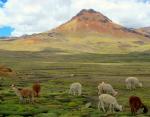
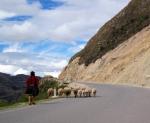
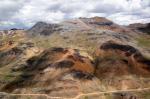
We are now in the midst of Peru’s Central Highlands, immersed in uninterrupted wilderness. It is rocky, remote and feels like Peru at its most Peruvian. For hours at a time, the only signs of life are the passing herds of llama, alpaca, and vicuna. With each new turn we are faced with a new and starkly beautiful view.
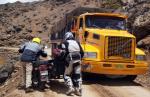
On a particularly narrow stretch of road, balanced on the edge of a cliff, we come across a truck – a big, wide truck. We maneuver the bike against the rock wall on one side of the road to provide space, but this doesn’t give the truck enough space and now the bike is sinking into the soft roadside soil. Once we get unstuck we try the other side of the road. With one tire off the road and beginning to slide downward, Miles and Stefan are both clinging to the bike to keep it from sliding completely off of the road and down the steep slope. As the back-end of the truck passes, its rear wheels scrape the side of the Ural. There is no room to spare. Finally the truck makes it past us and it takes some careful footing and super-human strength to push the Ural back to safety on the road. Whew! Disaster averted.
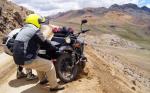
The next morning the roads become steeper and less road-like with every kilometre. The altitude is taking its toll on our horsepower and finally the lack of speed and difficulty of the terrain causes us to stall to a halt. We try to continue but smoke pours from the clutch and the reality is that I will need to tackle the next couple of steep corners on foot as it is the only way to reduce our weight enough to complete the climb.
A short while later, we face a repeat situation. This time we decide to do some load-swapping, moving one of Stefan’s bags into the sidecar while I move to the back of Stefan’s bike. It is a nice change of pace riding on the back of the bike but I quickly remember how tiring it can be – holding on, balancing, feeling every bump. I’m missing my cushy sidecar.







 Smiles & Miles