JOURNEY TO THE MIDDLE OF THE EARTH

And beyond…..

”Oops, forgot to watch the GPS and drove right by the equator 10 miles ago”.

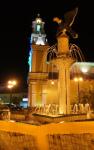
After an hour trying to get to the park at the equator, we arrive just as the day is winding down. We take some obligatory photos wobbling on the line painted on the ground and decline the offer to spend 10 bucks to go up a couple of stories to see the line from above.

“Hey, let’s go flush the toilet and see which way the water goes.”  So we do. “Hmmm… I don’t remember which way it goes at home.” Our big experiment in gravity, physics and snake oil is a bust. Stefan furthers the bust by saying “Well it depends how the toilet is made anyway so it’s not the right experiment”.

It’s getting dark so it’s time to find a place to stay. The place to stay ends up being a wonderful little hotel 30 feet from the equator and staffed with a great collection of little old ladies who are so friendly they can’t stop hugging us and getting lipstick all over the place.

Ecuador has been an interesting place so far. We visited Otavalo – a town made famous by its handicraft market. It must be in every guidebook. Tourists outnumber locals and all of the locals magically know enough English to try to sell us something. We emerged unscathed and wandered into the local food market.

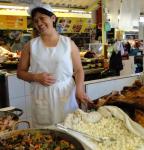
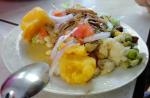
The food market was just preparing to open. The stall keepers were having breakfast. After some charades I convinced a lady to make me some breakfast. She returns with what turns out to be the best meal of the trip so far. I received a plate filled with potatoes blended with a collection of roasted vegetables, beans and topped with roasted ‘corn nuts’.  The flavours were fresh and vibrant and the combination was a perfect way to start the day. Oh, and Stefan (the disbeliever) goes and orders up some horrific deep fried gristle, perfect for teasing dogs, not so good for eating. Good thing they have roast chicken next door to the inn where we are staying.

As we leave Otavalo and Quito behind, Ecuador continues to be a treat to drive through. The roads are good and the terrain is constantly changing. We wind along country lanes and minutes later find ourselves at the bottom of rocky valleys. The high mountain passes are as dramatic as any we have seen.

When we pull over for lunch in Ambato, a passenger in a truck hops out and waves us down.  He starts waving a cell phone at us and saying “Here, you must speak to my friend”. Soon we are in a conversation with his English-speaking friend, Julio, who is on the other end of the line.  Julio Velastegui (www.juliovelastegui.com) is another motorbike traveler and when his friend saw us, he knew that we had to meet. After getting our location, Julio quickly heads down to join us.  We once again learn how small our world is when Julio shares the story of meeting another fellow motorbike traveler, Sherri Jo Wilkins (www.sherrijowilkins.com ), while he was on the road in Canada earlier in the year.  Coincidentally, we also spent time with Sherri Jo earlier in the year, both in Canada and in England.   

South of Cuenca we arrive in a small mountain-top village named Catacocha, where every road is being worked on at the same time. After navigating what looks like a war zone, we find a hotel that turns out to be a very clean and very affordable home. We like it enough to stay an extra day.

Tracey’s birthday happens while we are here and we enjoy a night out on the town. Literally, a night out on the town.  While a woman is making us a one-pot dinner, we sit on lawn chairs in the middle of the street with a bare light bulb swinging precariously overhead, the bare wires threatening to electrocute any one of us at any moment.

We use our time in Catacocha to do some maintenance and take care of our trusty steeds. It is during this time that I become part of a scene which will occupy my thoughts forever. An old man is trying to move along the street. He is missing one eye, has a club foot and is barely able to move. He can only shuffle sideways and it takes him a full ten minutes to make a step. After four hours the man has progressed about 100 feet. I don’t know where he is going, but it will clearly take a long time.

The man is proud.

He does not ask for money.

He does not beg.

He does not look for help.

The rest of the people pass by him and go about the day, seemingly unaware of his presence. The sidecar would be a perfect way to get him where he is going but our ability to communicate the desire to help him fails. We leave him to his lonely shuffle and I can’t help but think of how excessive our own world is in comparison. We drive 15,000km with less effort than a stroll in the sun for this man.

I have learned another lesson today.

The image of this man’s trek will stay with me forever.

I use the word trek. For him, simply getting to the end of the block would be an all-day task.

Miles

This slideshow requires JavaScript.

Ummmmm…………LUNCH IS LOOKING AT ME

Colombia.

Home of even more great roads.

The Colombian road builders have a great sense of adventure. I can picture the discussion, “Don’t build the road through the valley, let’s see if we can actually make it follow the ridgeline all the way. Twenty pesos says you can’t”.

I’m glad someone took the bet.

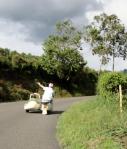
The roads are spectacular:  1000 foot drops on each side of the road, pavement twisting along the ridges, fog sweeping up the hillsides increasing the drama of the region. We follow a local semi-truck.  He is pulling a full-size trailer. The road is two lanes with no shoulder. After an hour of trying, we can’t pass him. It isn’t that he is blocking the road.  We can’t pass him because he is flying!

I try my best to keep up by sticking close and following his passes. “If he is going it must be safe, right?” It’s a good thing that the game only lasts an hour.

The tires are squealing,

the brakes are squealing,

the wife is squealing. 

Then we reach the valley floor. A quick fuel fill up and we’re off to repeat this game several times over the course of the day. Any of the passes would see me arrested in our home country but here in Colombia it is how you get it done.

It’s another national holiday. 

Sancocho, one of Colombia’s favourite dishes is on the menu for the special occasion.  So we gotta try it. But what is it? Pollo. Chicken – sounds good. Order up three.

Course one arrives – chicken soup. Looks good. Tastes great. What’s next?  Sausage – sort of.  The next course arrives. Ummmm. Why is my lunch looking at me? It is about 6 inches high, a chicken neck with the head still attached, all the inside removed except the eyes and it is stuffed and standing up on the plate, staring me down.

It is tasty, but I have to eat all three.

Stefan and Tracey decide that it is not for them.

We stop in a village just south of Popayan to find accommodation.  A kind gentleman on a motorbike offers to assist and leads us to a place south of town where we are greeted by a friendly family who shows Tracey a room that is available for the night.  As she checks out the room, she can’t help noticing that it is clearly being occupied.  There are personal items everywhere in the room.  As she looks around, members of the family are hustling around clearing up all evidence of inhabitation.  We accept the accommodation and within minutes the room is readied with fresh bedding and towels.  Shortly afterward, the family piles into two taxis and are gone. 

We never see them again.  Thankfully there is a caretaker on site who locks up for the night and makes a lovely breakfast the next morning, but I can’t help feeling as if our arrival has left the family without a place to stay themselves and picture them bunking with unsuspecting friends in order to make room for us.  Based on the hospitality we have seen so far in Colombia, this wouldn’t surprise me. 

The next day we have a surprise – the best burger I have ever had. We arrive in town in the dark, in the rain, in the cold.

Our hotel room is so small the door catches on the bed. No danger of falling out of bed – there’s not enough room! We are hungry. The restaurant is closed. The desk clerk hands us a take out menu from a local restaurant. Wow, some great local dishes on the menu.

But when we order we hear

“Nope, out of that.

Nope out of that too.

Nope. Nope.” 

We finally get down to “What do you have?”

“Hamburgers” is the reply. Well, I guess we will have burgers. The burgers arrive. They are unbelievable. Fresh chopped beef, a great bun, a slice of ham, cheese, fried onion, avocado, and tomato topped with a mysterious crunchy shred of something. In case that was not enough they put on a chicken breast too.

Chicken is like salt down here, it comes on everything. The burger is amazing, a complex collection of great flavours. I just about stay another day, just to have another one.

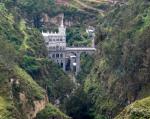
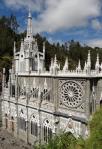
Our last stop in Colombia is at Santuario de Las Lajas, a strange but spectacular sight.  The neo-Gothic Santuario is built on a stone bridge spanning a deep gorge.  It’s also a hugely popular destination for pilgrims in need of a miracle.  Pilgrims’ plaques of thanksgiving line the walls of the canyon. They have placed their faith in the Virgin Mary, whose image is believed to have emerged from an enormous vertical rock 45m above the river sometime in the mid-18th century.  The church is directly against the rocky wall of the gorge where the image appeared. The church is a spectacular sight. 

Ecuador beckons – here we come.

Miles

This slideshow requires JavaScript.

AHH, THE SMELL OF COFFEE

Eventually, we make it to Medellin, a city that no traveler would have considered passing through fifteen years ago. The city was once known as the murder and violence capital of the world. Thanks to a massive effort by the government and a tremendous amount of local pride, Medellin is now considered a safe city and a great place to visit. The streets are clean and lined with scupltures and local artwork.

Later in the day we head into El Eje Cafetero (the coffee region), home of Colombia’s number-one drink and its biggest (legal) export.  The area is blessed with magnificent mountain scenery and coffee plants covering nearly every slope. In a country where we have seen many spectacular landscapes, this region provides the most beautiful mountain scenery yet. To add to the pleasure, the smell of coffee is strong in the air. I may not be a coffee fan, but there is no denying that the smell is fabulous.  

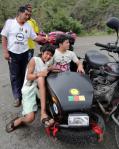
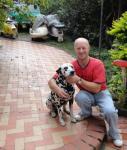
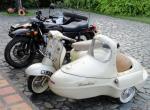
Our destination for the day is Pereira, the coffee region’s largest city. A chance encounter on our second day in the city leads us to the perfect home-away-from-home. As I stand on the side of the road fielding endless questions from the locals, a beautiful pale yellow Lambretta motor scooter pulls up behind the Ural, and off hops its driver sporting a helmet emblazoned with the Union Jack. I immediately recognize that this is not a typical Colombian. I am about to meet one of the most enthusiastic two and three-wheel motoring enthusiasts we have ever encountered, British expat Alan Gardiner. Our meeting was meant to be.  We learn that Alan has a farm near Pereira which commonly serves as a hostel for motorbikers passing through the area. We take Alan up on his offer of accommodation at Villa Toscana. Alan’s home, with its lovely garden and pool, proves to be the perfect place to take a few days’ break from riding. We also thoroughly enjoy Alan’s company as we share passions for music and motoring. Alan is undoubtedly a wealth of knowledge when it comes to British Northern Soul music and Lambretta scooters. He has several Lambrettas in his collection, including one to which he has added a sidecar.

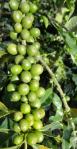
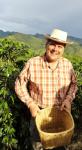
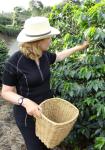
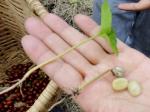
On one of our afternoons, Alan and his friend Luz organize us a visit to Villa Martha, an active coffee finca (farm). As we are in the midst of the main harvest time, we have an opportunity to go into the rows of small evergreen coffee bushes, seeing the coffee berries in various stages of ripeness. Berries are traditionally selectively picked by hand and we learn how to select berries at their peak of ripeness.  We pick several berries, peel them open to extract the seeds (commonly known as coffee beans) and then follow the beans through the stages of processing. First, the slimy layer of mucilage is removed from the bean, then it is washed to remove any residue. We watch some previously-picked beans finishing the roasting process and being ground and packaged. When we are offered a cup of sweet coffee at the end of our tour, I can’t refuse. Having just been involved in the entire process, I have to sample the final product. 

Tracey

This slideshow requires JavaScript.